Today I find myself very tempted to resume my reading of The Road to Reality by Roger Penrose. This is a book that was first gifted to me by my fried Floriano in high school, because he knew about my affinity for physics. What he didn’t know is how this book would feature in my existential crisis.
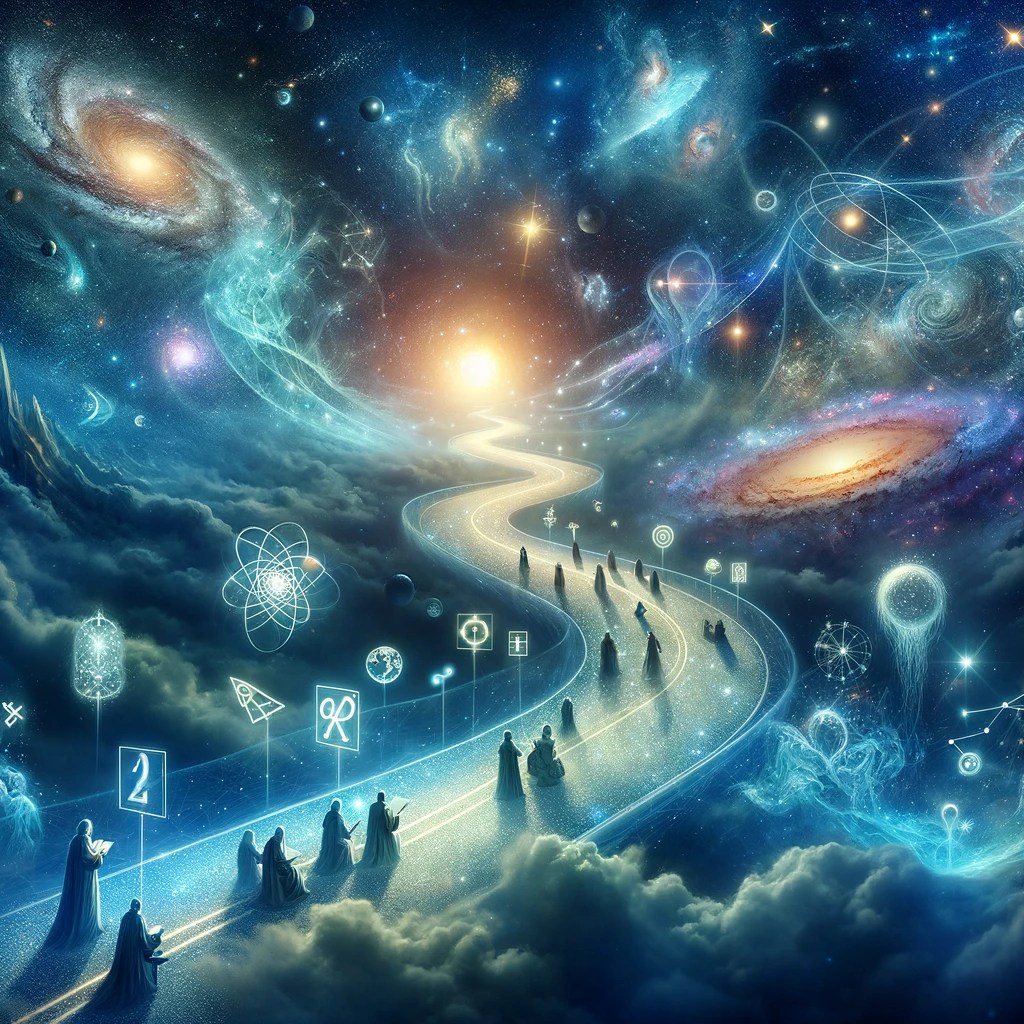
This book promises a “road to Reality,” which essentially seems to claim that the road is traversed through theorizing and experimentation, and that this road has an ending, which is Reality itself. It seemed to me at that time that nothing could be more pressing than understanding and indeed memorizing every step along this road for its own sake—that is, for the sake of grasping what the hell is going on around me. It also seemed to me to be the peak of intelligence to understand and to be able to explain all these steps. This created the existential crisis of feeling that I need to understand everything that is written in that book in order to have even a working grasp on what is going on around me; and without such a working grasp, how could I be called intelligent?
Now my view is, thankfully, different. In my years since college, I have taken a step back and asked the meta-questions that I took for granted, such as: how can we claim justification for our scientific and mathematical knowledge at all? If we found the correct model of fundamental Reality, would we ever know for sure that we have? How could we guarantee that Reality itself would never change? This is, in other words, the problem of induction: can we guarantee that the future resembles the past, or is this an assumption we make? I think the latter.
Once I pondered these philosophical questions, I realized that the answers are more or less a matter of faith, since these questions do not lend themselves well to assertions that are falsifiable by reference to a manipulation of Reality. Therefore, the “road to Reality” is more like a “road to Concept,” to use my own philosophical terminology, since ultimate Reality may be epistemically beyond taming.
Another question that relieved the existential urgency of understanding The Road to Reality was this: if we had a correct model of fundamental Reality, would we still need the other sciences and disciplines that operate over concepts that are at a higher level of abstraction? I think we would. For example, according to a fundamental physical model, no two jaguars are the same at all. Does this mean that there is no such thing as a “jaguar”? Even if we had a fundamentally correct physical model, we would still need to talk about the concept of “jaguar” as if it exists in a meaningful way. So we would need a “chunked” concept of what constitutes a “jaguar,” even if it is in terms of that fundamental physics. Indeed, it would likely be very inefficient to talk about what constitutes a “jaguar” in terms of that physical model; and so we would continue to need biology. The takeaway from this last line of thinking is that understanding a fundamental physical model would actually leave one still very far from a good model of what is happening around them day-to-day at the level of “chunked” concepts.
Concurrently with all this questioning, I began to ponder a further set of questions: What are we actually doing when we do science, i.e. what is the methodology? How can the methodology itself be modeled and physically realized? These are questions that do lend themselves to falsifiable hypotheses, especially in the nascent fields of cognitive science and artificial intelligence. This is where I find myself now.
I still do want to finish reading The Road to Reality in order to understand what cool physical models and mathematical constructs we have come up with as we try to map out entities that don’t make conscious decisions. But unfortunately I don’t have time to study both my old world model—a physicalist picture of fundamental entities interacting randomly by unchanging natural laws—and to develop through research and learning my new world model, which is really a meta-model of sorts: a world in which agents form conceptual models in order to navigate an ontologically and epistemically “open” fundamental Reality, models which shape their behavior, embedded as they are within Reality, and consequently dictate the evolution of Reality itself.
I wonder if navigating these questions will reveal that these are two poles of opinion, and that there are middle ways or transcendent resolutions to be discovered; or alternative views altogether. But for now I need to focus on the task at hand, which is engaging with my PhD in Systems Engineering—a perfect place to be in order to continue exploring these philosophical questions!
 The Trinitarian Mystery
Leave a comment