A Wave

There is a place, a starting point for thought,
Where the wave is not a breath, nor an unseen excitation;
A time when the ocean wave is entirely and only itself.
Here I see the space is vast that isolates a lover,
And turbulent the time
	that shakes the brittle tie of one to one.

If I should cast a stone at the wave in my conceit,
	might it stir the olivine sea
on distant shores
	to break at your feet?
And might you then marvel at how beautiful the world can be?

Though we insist our borders hold,
	I plainly see
		What is of you
			but in me.
This is the oldest poem in my collection—the first I wrote as a freshman in college. It was indeed a “starting point for thought” for me.
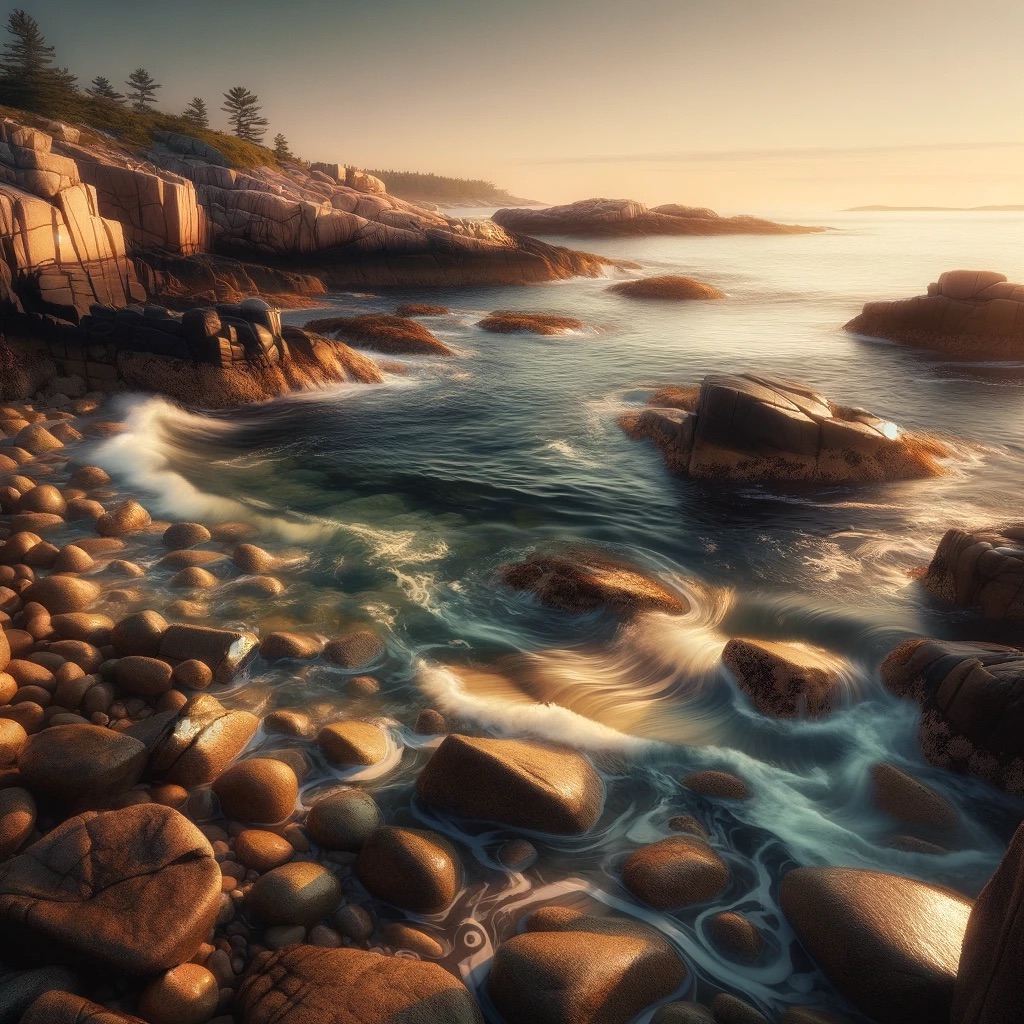
It was winter when I wrote it. There was a place I would go to think, a little nook in the rocks on the shoreline in a small town near Boston. I would watch the waves crash and break at my feet for hours on end, until the cold or the tide dictated that I should go home.
At the time I was grieving a close relationship, studying physics and theoretical mathematics at university, and reading such figures in classical Chinese philosophy as the Laozi, Confucius, and Zhuangzi.
Amidst this expansion of my worldview, I needed a place to anchor my thought. I felt that I was swimming in new concepts, and I needed a basic way to hold what I had known and what I was learning. I anchored my understanding in a great and generative paradox.
At once, the wave is entirely and only itself; it is irreducibly individual. Even the concept of a “wave” is an abstraction, a many-to-one mapping of real facts to a neat concept that ignores the “suchness,” or haecceity, of each wave itself—that irreducible individuality that escapes full linguistic or mathematical capture.
At the same time, there is no clear division between a wave and the rest of the ocean. It is part-and-whole simultaneously. One can draw a division, but the border is shifting, permeable, and ultimately arbitrary.
I began to notice that the division between myself and the rest of Reality (and by “Reality” I mean that which IS, prior to anything we may say about it) has a similar character.
Once I have declared my borders (my skin, perhaps) in any given moment, I as a subset of Reality have an irreducible individuality. I may be conceptualized many ways, but I retain my haecceity, my unique “suchness.”
At the same time, I am part-and-whole of all that is, as the wave is to the ocean. Wherever I draw the line between self and Other, there is a blending and an interchange—a dance of sorts. The “Other” is continuous with and in constant interchange with “self.” This is a coordinated process of being and becoming.
What does this mean for us, concretely?
Well for one, this idea is experiential: let it be a starting point for thought, and see what comes of it.
See if you can notice that when you conceive of your self, your ego, you do so in relation to some imagined Other. You mutually conceptualize the agent and the arena, to borrow cognitive scientist and philosopher John Vervaeke’s terminology.
Now realize that that Other is not alien from and discontinuous with your self, but likewise part-and-whole of the same unified Reality.
If you’ll indulge it, notice too that in this very moment I am coming to you as that Other, with a message of great love and good tidings.
Indeed, when I started posting my poetry, I had no followers and no engagement. I was very much casting “a stone at the wave in my conceit.” It seems now that the olivine sea has carried the wave to break on your shore.
Let us marvel at how beautiful the world can be.
 The Trinitarian Mystery
Leave a comment