Conversation with a Tree

I ask the tree,
“I know that my binaries are spectra,
and every name’s a judgment.
Any walls I have ever built worked both ways.
But how far can I extend?
And If I start, can I stop?”

It says,
“I grow upward because there is no limit;
If I began from a height and extended downward,
I would have fixed my potential from the start.”

I ask the tree,
“I know that there is neither headwind
nor tailwind if I am still;
And yet it is the stillness in her eyes
that carries one moment to meet the next;
And so time takes its hold on me.”

It says,
“Stillness is a matter of scale
and headwinds a matter of facing.
I have no face and am on many scales,
so I don’t know what you’re talking about.”
I recently had a chance to clarify some of my philosophical positions, and I would like to share those reflections here. These reflections and definitions are the key to “unlocking” my poetry, including the above.
By the way, the poem above is an homage to Wislawa Szymborska’s “Conversation with a Stone,” which I read during my freshman year of college and which had a strong impact on me. The idea in that poem of lacking “a sense of taking part” influenced my conception of the individual self as “holon.” I explain this idea and more below.
Process and object orientations
At a very basic level, we have to understand that we see ourselves and our world in three dimensions at all times, but we actually exist in four dimensions. If my life is a tree, then I am looking at any given moment at a cross-section of the tree. I can infer some information about the higher and lower parts of the tree from my cross-section, but the exact nature of the entire tree remains a mystery to me. To view self and world in the “object orientation” is to discuss the cross-section of the tree, while to take the “process orientation” is to discuss the whole tree.
Even though we may understand that we are in some sense a process of becoming, when we think linguistically we tend to think in an object-oriented manner. This is due to the nature of language, which is inherently object-oriented. There is nothing wrong with this per se: both process and object orientations are useful. But reliance on one orientation without recognition of the other is likely to lead to confusion.
The Real as “pregnant emptiness”
The world prior to abstraction is a pregnant emptiness, full of the potential for information.
What is information? In the words of Gregory Bateson, information is “a difference that makes a difference” within a system. That is to say that information is foremost contrastive. Something must be distinguished against a background: a uniform field contains no information because there is no difference to drive the creation of any further difference. This is why a binary scheme can be used to encode information: there must at least be contrast to drive change.
The additional clause I tacked to the end of Bateson’s pithy definition is intended to highlight that information is also system-dependent: information is always information-for-a-system. Information is not something that inheres in an object or signal, but is rather a process of detecting and reacting to difference.
So while information as an “object” may be thought of deriving from or consisting in contrast within a signal, information as a process is a contrast-ing. It is helpful in this “process” mode to think of information as a verb: “in-formation.”
At the local level, each moment of consciousness is an act of in-formation, the shaping of a specific experience or perspective out of the field of possibility through the selective attention and reaction to certain patterns of contrasts.
The individual self as “holon”
A holon is something which can be regarded usefully as a whole system unto itself, but which is continuous and interconnected with a higher-order system. It can be thought of as analogous to a subroutine of a function.
An example of a holon is the stomach: the stomach can be studied on its own as a coherent unit of analysis, and yet it is embedded within and interconnected with the rest of the body system.
A conscious being may also be considered a holon. But if a conscious being as holon is analogous to a subroutine of a function, then what is the universal “function” of which the conscious being is a “subroutine”?
Well, first of all, a conscious being may be considered to be embedded within and interconnected with larger social systems, such as the family, a company, society, etc.
But the overarching, universal process within which a conscious being is embedded as a holon might be called the contraction and expansion of information.
What do I mean by “the contraction and expansion of information”? The “contraction of information” means the selective boosting of certain patterns of differences within signals via attention, causing a collapse between the arbitrarily high-dimensional raw data and the lower-dimensional concepts upon which an agent acts; and then “the expansion of information” is the reaction to concepts, e.g. action motivated by concepts, which is itself part of the arbitrarily high-dimensional potentiality. Therefore our reaction to concepts feeds back to our conceptualization, constituting a recursive process of self-creation.
Pregnant emptiness as the higher-order Self
The aforementioned pregnant emptiness is the ground of being, which resists final conceptualization but which births all concepts. It has been called the Tao, Brahman, or God. The individual self emerges from and is continuous with this higher-order Self.
In other words, there is a lot more Me than the “me” that appears to myself when I look for it. There’s the Me that is looking for it, the “me” that is being seen, and the me-ing that is the process of looking and being seen. And they are all three the same.
This is the mystery of the tripartite self: self as object is both the unseen Seer which is partially crystallized into concept in the seen; and in the process orientation, the self is the very process of looking and being seen.
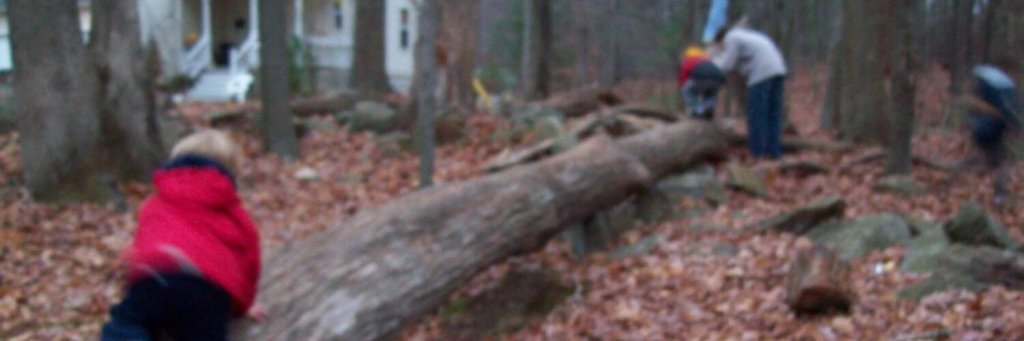
Pictured below is the fallen tree that I grew up playing on. To a child, a fallen tree is so pregnant with potential conceptualizations: it was tree, boat, car, train, horse, obstacle course, table, support for a lean-to, and more. In truth, this tree was a friend to me and a fixture of my childhood.
Thanks for reading!

 The Trinitarian Mystery
Leave a comment