Upon Awakening

For what was I born?

What did you want from me, you
who woke me from my slumber?

Or did you just wish to show me
what it was to be awake?

To be surprise itself.

To talk with a bird, on a walk, too
small for my hands.

To know the crunch
of a pinecone underfoot.

To feel the warmth of my wife as she sleeps.
And to fall asleep beside her.
I was asked recently about my thoughts on predetermination and free will. I want to record here a few reflections on the subject.
I hold all beliefs expressed herein like a useful map by which to navigate existence, rather than as an absolute or certain truth. I am not asserting any objective ontology or metaphysical truth. Rather, I am beginning with a clear-headed view of the limitations of language and hoping to articulate a practically helpful, morally just, abstract worldview that can influence my ongoing development.
I am sure that there will at least be food for thought—and hopefully for discussion too! Leave a comment if any part resonates or seems confusing.
On Co-Creation of the Self
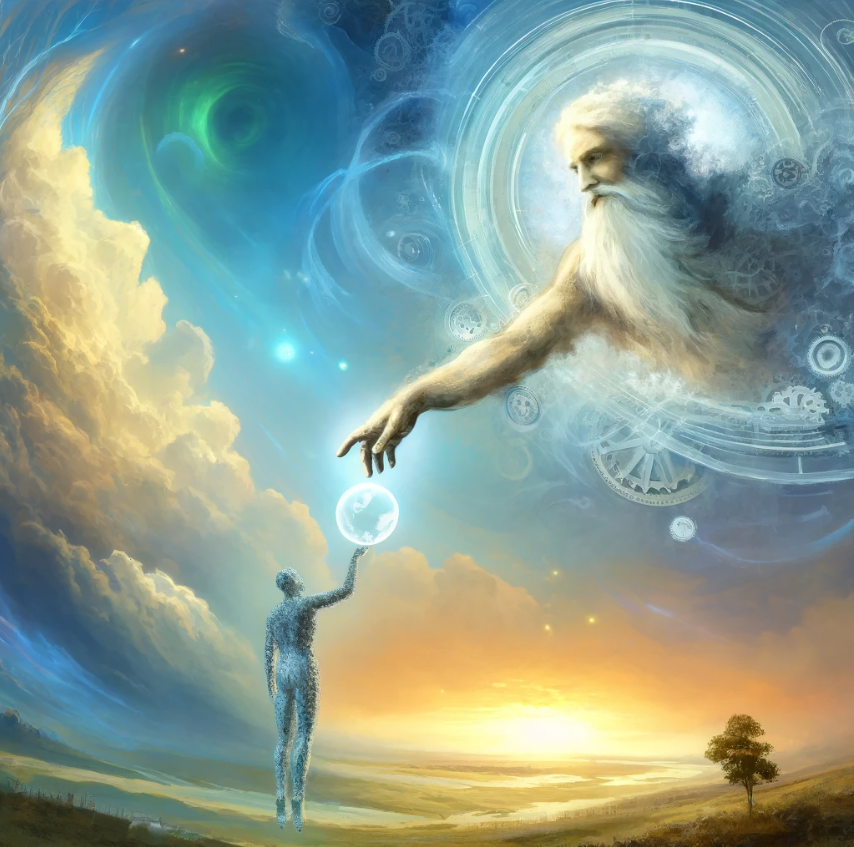
I’ll start by explaining some background terminology and assumptions. My basic faith is that I and God co-create myself together. I take “God” to be a pointer to That/He which IS, no matter what else we may say about it. I am a holonic subset of God—a subsystem embedded within, continuous with, and defined in interchange with the whole system, which I call the Totality, or God. For more on the meaning of “holonically,” see here or here.
Why call this Totality “God,” instead of merely “the universe” or “reality”? You can call it what you like. One answer to this question, though, is that I am partially responsive to Pascal’s Wager (see this post). Another is that viewing as “God” the Totality of which one is a holonic subset simply changes one’s personal experience of existence.
For one thing, it introduces new relationships that one can welcome into their life: a relationship with all the “Other” or the “not-me” (That which is other than myself) and the “big-Me” (That which is a superset of myself). In this sense, a relationship with God becomes participation in a certain Trinitarian structure: knowing oneself to be relative to an Other, and knowing oneself to be a part of a larger gestalt with that Other. This larger gestalt may be called the process of begetting the individuated selves from the total Self, or God.
Obviously, the use of the word “God” also “comes with” a lot of language and memetic structure that has been carefully developed over millennia and then taught to me when I was a child, so I have a bias toward this language.
Assuming this notion of God for now, the basic assumption that I co-create myself with God strikes me as fairly intuitive. I am undeniably a subset of That which exists prior to anything we say about it: I cannot deny that I exist, because I must exist in order to deny it. I also cannot deny that I hold certain beliefs, because to deny it would be to hold a belief in the opposite. I also seem unavoidably to be a co-creator of myself (and here I mean the ordinary, individual sense of myself—the ego) causally, because my past beliefs and actions have directly influenced my future states, and in particular my current state as I write or re-read this.
But I don’t create myself alone in that process. It is not only my actions that have mattered in creating my current state, but my actions and the response of the “environment,” or, as I prefer to call it, the Other (the rest of the Totality, or God). So then I and the not-me are of course co-creators of my ordinary sense of self.
In particular, this is true no matter how I define “myself.” I am necessarily relative to the not-me; and our relationship is the whole of the ongoing creation.
Obviously I am also the “created” self at any given moment: however I identify “myself” in a given moment, it is that which has been created by my past momentary selves and Others.
And finally, God is the very process of creation of my new self from my previous self and Other. That is, God is the process of interaction between momentary selves (that with which I identify in a given moment) and momentary Others (that with which I do not identify). That is one metaphysical description of the process that has brought me to my current state, which I take therefore to be my creator. So then I am co-created, embedded within and co-evolving with God Himself.
The way that this process itself works is in analogy to creating narratives about myself. In this analogy, I am the storyteller, the embedded character within the story I am telling, and the ongoing reaction of myself to the narratives I am telling myself. I’ll illustrate this with an example.
My thoughts are like broadcast commentary. Due to the lag time between the occurrence of an event in reality and my perceptual and conceptual processing of it, I am always a little “behind the action.” Despite this, the commentary makes predictions about the current and future ongoing behavior. For example, an announcer may highlight a key player to “look out for” during the game. In “calling the play,” the commentator chooses what happenings to highlight and what information to emphasize. In this way, the broadcaster represents a sort of filter for the information on the field to the less-knowledgeable viewer. The broadcaster is, in other words, a mechanism of selective attention.
If my thoughts are like broadcast commentary, then I am also the players on the field; and it is as if the players can hear the commentary itself in real-time. In deciding how to take actions, I am “hearing my commentary” on what previously happened and predictions on what will happen. This sort of open-loop control, or feedback, between perceptual and conceptual processing and executive processing seems to be a basic condition of my existence. Crucially, my action in turn interacts with the environment, or Other, to produce the feedback to the process that shapes my ongoing development.
So there is a coupling between my perceptual and conceptual processing and my executive processing, and all of my processing is coupled in turn with the responses of the environment. This is what I consider to be co-creation with God.
On Free Will
Now, we cannot reduce the will of the person to nothing in this process. The fundamental reason why is that we cannot attain a complete, true description of reality; and even if we could, we would never know that we have. I have argued for this more thoroughly elsewhere; but here I take it for granted.
If we cannot in principle attain a complete, true description of reality, then the question of free will is ultimately indeterminate. Indeed, it follows that every question is ultimately indeterminate, because there is no objective and complete absolute Truth of the matter that can be found. Answers to questions are always provisional and subject to revision based on better argumentation or new information.
If we acknowledge this with intellectual humility, then “objective” or “absolute” truth is no longer the only guiding factor in how we choose to endorse or disagree with proposed systems of truths. In particular, we can consider the efficacy of systems of truths at achieving the ends for which they are intended, and we can make moral judgments as to both the intended ends and the unintended consequences of a system of truths.
Considering this universal position of intellectual humility and fallibility, we can never exactly predict another’s actions. We may effectively be able to predict another’s actions to a high degree of accuracy in an abstract task, such as, “Will press the button,” or, “Will not press the button”—but the exact reality can never be measured and known absolutely precisely. The map is never the territory. As such, even though some version of determinism may be inevitable from “within” a system of truths, or according to some “map,” in the larger context we cannot ultimately rule out free will in the “territory.” Perhaps free will is itself a sort of causal singularity of recursive physical self-reference that our present language and logic cannot fully accommodate.
Christ as the Ideal
If we accept the possibility of free will, and if we make the assumptions outlined in the first section, then let us explore the implications theologically.
We begin from the hypothetical premise that the will of God is that we should ourselves have will. We also suppose that we should love ourselves. The edict to, “Love thy neighbor as thyself” means nothing if it does not presuppose that one ought to love oneself. Therefore, since we should have both will and self-love, one might assume that we are free to act in our own self-interest to some extent.
Yet at the same time, we are called to submit our will to the will of God. We say, “Thy will be done, on Earth as it is in heaven.” And in the example of Jesus, we are shown to love the other even to the point of anguish and death. So then are we called to have self-love without self-interest? I am meant to love others as myself, but I am called not to resist evil for my own sake; so then it seems I should not resist evil for others’ sake either. What sort of love is this?
Christ and his mother, Mary, set the ideal. They were canonically born without original sin. In other words, they intuitively felt no separation between self and Other, subject and object, but rather deep, intuitive unity. We who are “originally sinful” in the respect of feeling ourselves at first intuition to be separate from God can only set Christ’s death as an ideal or aspiration. And on the other hand, Christ’s resurrection justifies the belief that this sort of ego death is not the end of life. On the contrary, there is an expansive and eternal awareness to be joined.
So then to love the other as oneself and not to resist evil is to identify oneself in communion with the other and with God, who sets the conditions within which individual selves co-operate. It is a call to ultimate acceptance of God’s will, together with respect for the other’s inherent dignity as a creature of and co-creator with God.
Taken together with the earlier metaphysical picture of the co-creation of self with circumstance (or with God, if you prefer), this paints an interesting picture. We are called to aspire to ego death and union with the Totality, while at the same time being co-creators of our own egos.
One resolution to this apparent paradox is not to reify the ego even while one continues to construct it: to stop trying to be someone or something in particular; not to try to answer, “Who or what am I?” definitively and finally, as if I am a timeless object with properties and relations that can be definitively and finally known.
The ego is merely provisional, but what persists eternally, if anything, we may call “the soul.” Whether the soul is material or indeed utterly vacuous I cannot say definitively from my limited perspective. What I can say is that the soul, as a concept, serves the role of the pure signifier of the person. It is the symbol which unifies their processual being into thing-ness itself.
The soul is like one’s name in the mind of God. Before a child is born, there is just a name in the parents’ minds; the child itself is potentiality. All characteristics of the person follow after the name. The unchanging name “points to” the person, growing and changing as they are through interaction with the environment.
To have faith in the soul is to commit to a process of unification and self-becoming. The soul is a conceptual string which passes through the beads of our momentary selves to form a unified whole. The referent of the soul is the self-as-process. In other words, the soul “points to” the actual, processual self that one consciously creates by unification through time. We are called to develop the referent (or “signified”) of our soul in the example of Christ, to align our process of ego-creation and action-taking with the highest calling of our soul: to love God with all our heart, with all our mind, and with all our strength; and our neighbors as ourselves.
After all, constructing (but not necessarily reifying) a provisional ego is inevitable. Even Christ on the cross cried out, “My God, why have you forsaken me?” In other words, he felt himself to be an individuated self in that moment. To have faith in the soul is to identify with a continuous self, before, behind, and between the provisional ego appearances, while the call to love and communion with God and neighbor is a call to identification with a higher-order Self—that is, to ultimate union with God.
Insofar as we construct a provisional ego, we are called to submit willingly to the Will of God in that which we cannot change, in order that we may effectively respond in taking action on that which we can change. This harkens back to the famous Serenity Prayer from 12-step programs: “Grant me the serenity to accept the things I cannot change, the courage to change the things I can, and the wisdom to know the difference.” Moreover, when deciding our own actions, we are called to base our morality on the principle of love for the other individual soul in the example of Christ, even to the point of suffering and death.
Suffering and the Problem of Evil
So here is the full picture: we are co-creators with God of our own egos. But at the same time, the ego is not a reality itself but a symbol for a reality—the provisional map, not the ever-shifting territory of what we are. The soul, as a concept, is the eternal signifier of the person—the unchanging symbol of the self-as-process. As we create the provisional ego by our perception, conception, and action, we co-create reality itself in a coupled manner with the environment, and we give shape in particular to the referent of the soul, though its exact nature cannot be known to us. In planning actions in this process, we are called to aspire to the example of love for others even unto the point of suffering and death. In this way, Christ and the Virgin Mary set the ideal.
And yet, God in his mercy allows for self-interest and even indulgence within limits. God allows us to concentrate our love on a relative few people rather than loving everyone truly equally. God also allows evil, and he allows immense, gratuitous suffering.
One answer to this evil and suffering is to postulate that it is not without recompense in the afterlife. God gave over his Earthly endeavors to co-creation when He created Adam and Eve in His image and likeness. Our reality is co-created between selves, with God the overlying and interpenetrating Self in a relation of deep communion with each individuated consciousness. God suffers with the victims of sin, literally, even when they feel they are abandoned, as Christ did. God looks after the victims of sin in heaven; and the wicked who do not forsake their ways are justified by punishment before ultimately taking their rest.
An alternative answer to the philosophical “question of evil” is that since we are co-creators of Reality imbued with the divine spark, the response of God to suffering is dependent on our practical response to the suffering we experience and witness. In other words, evil is not a mere philosophical puzzle but a call to moral action, to love and mercy for the other and for ourselves.
Conclusions
We began with the question of free will and predetermination. What I hope to have shown is that free will cannot be ruled out definitively. And if not ruled out, I have argued for a coherent narrative around the co-creation of self and God, morality, ego reification, and suffering.
Of course, by my same arguments, we cannot absolutely rule out predetermination or determinism either. We may even be likewise able to argue for a coherent worldview taking predetermination as a foundational belief. Ultimately, the decision between competing worldviews comes down to which worldview is internally coherent and consistent, what it aims to achieve, how effective it is in achieving those ends, and what its unintended consequences may be.
One goal of the view presented here is to unify postmodern and processual views of the self with a Christian mythology. Another goal is to effect positive psychological change in the faithful (in other words, in me). It is to unify the mundane with the divine. I have found it to be very helpful in this regard.
The question of free will versus predetermination remains ultimately unresolved, as we cannot attain absolute certainty about the true nature of reality. However, by embracing intellectual humility and the possibility of free will, we can construct a coherent Christian worldview that emphasizes the co-creation of the self through the interplay of individual agency and divine grace. This perspective acknowledges the provisional nature of the ego while affirming the eternal significance of the soul as a symbol of the self-as-process. It calls us to emulate Christ’s example of selfless love, even in the face of suffering and evil, while recognizing that our response to these challenges is an integral part of God’s ongoing creation. By unifying postmodern and processual views of the self with Christian mythology, I hope to offer a framework for personal growth, existential meaning, and spiritual transformation in an uncertain world.

 The Trinitarian Mystery
Leave a reply to Reality isn’t indifferent to your questioning – The Trinitarian Mystery Cancel reply